The Admonitions Scroll at the British Museum: See It Any Day, the Original Six Weeks a Year
Updated 2026-06-27 · Guide Zaizai
At the British Museum you can, in fact, see the Admonitions of the Instructress to the Court Ladies almost any day — but on most days what you see is a high-resolution digital screen in the Chinese gallery (Room 33), not the painting itself. The thousand-year-old silk original appears in its own gallery for only about six weeks each year. Understanding this painting starts with knowing which version you're looking at — and then how to see it.
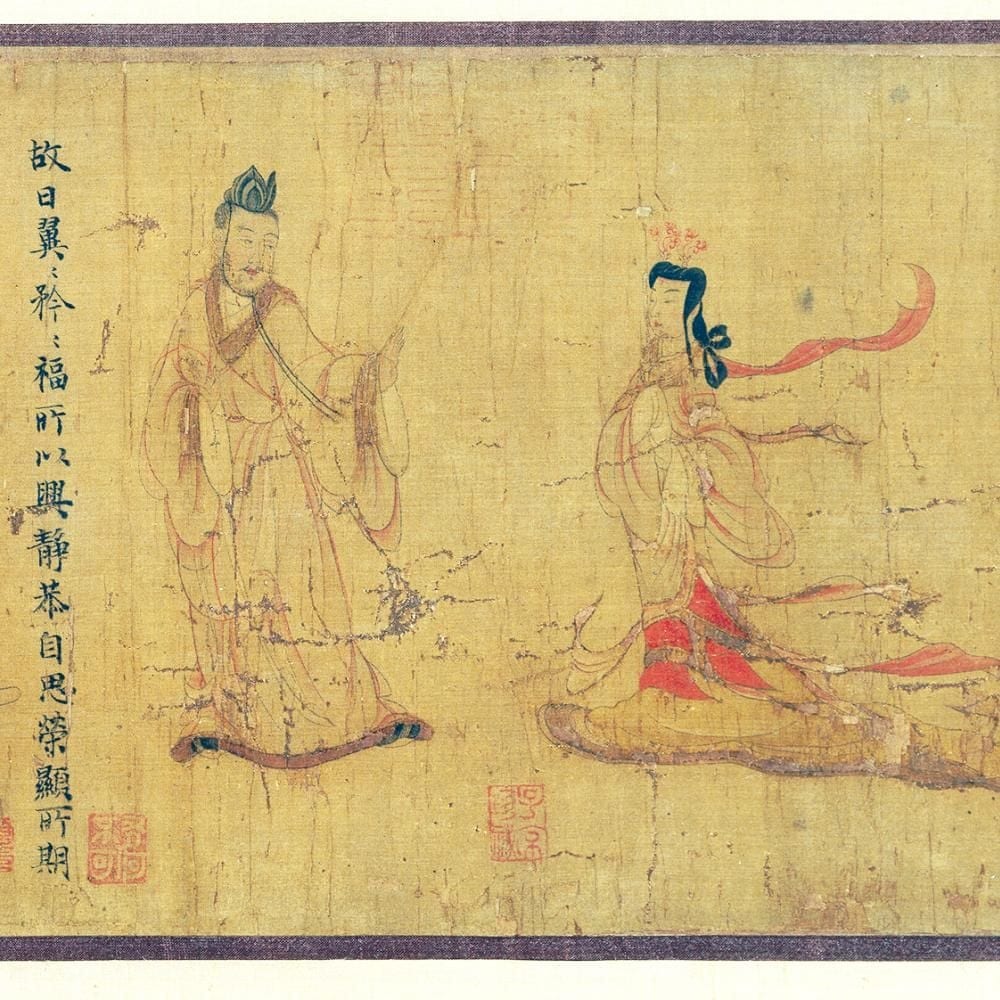
Why it is a national treasure
Traditionally attributed to Gu Kaizhi (c. AD 345–406) of the Eastern Jin dynasty, the British Museum's scroll is generally dated to AD 6th–8th century — a Tang-era copy. Even as a copy, it is one of the oldest surviving Chinese paintings on silk.
Its importance is its originality: it is among the earliest works to combine calligraphy, text and painting in a single handscroll, setting the template for more than a thousand years of Chinese literati painting that followed. It illustrates a poem, the Admonitions, written by the Western Jin official Zhang Hua (c. AD 232–300) to correct the conduct of an empress — scene by scene, it depicts the virtues expected of women at court, each section carrying its own allusion and moral. Gu Kaizhi's flowing, "silkworm-thread" line is on full display. Later collectors included Emperor Huizong of Song and the Qianlong Emperor, whose seals and inscriptions still mark the scroll today.
Why the original is shown only six weeks a year
This is not marketing scarcity — it is a long-term conservation policy. Silk is extremely light-sensitive, and after convening international experts in 2013, the museum settled on a strict limit of about six weeks per year. The scroll sits in a bespoke, fully climate-controlled case in Room 91a, with light levels held at roughly 40 lux.
In other words, "only six weeks" means it comes back every year — a fixture you can plan around, not a one-off you miss forever.
A painting that survived against the odds
The scroll's own history is dramatic. During the events of 1900, a British army officer took it from China; in 1903 it was sold to the British Museum for just £25. Once there, it was mounted in the Japanese screen style, which cracked and damaged the fragile silk. It owes its survival to the long, careful care of the museum's Chinese painting conservators, notably Qiu Jinxian — which is why we can still see this thousand-year-old work today.
How to see the original: a booking guide (good for any year)
- When: it usually goes on display for about six weeks in summer. Entry is free, but you must book a free timed ticket in advance.
- Ticket release: during the run, all timeslots for the following week are released every Monday at UK midnight. Mainland China is 7 hours ahead of UK summer time, so that's 7am Beijing time — log in a few minutes early.
- Limits and entry: up to 6 tickets per group; slots are about 10 minutes. Enter via Room 90 and queue in Room 91 for your slot — do not queue early.
- Bonus: a timed ticket also lets you straight into the main museum; no separate general admission booking needed.
- Note: exact dates change each year — check the British Museum's official page for the current run (for reference, in summer 2026 it runs 13 July – 24 August).
What if you miss the display, or can't get a ticket
This is exactly where "see it any day" comes in:
- Membership: British Museum Members can view the original without a timed ticket, any number of times during opening hours.
- Same-day spares: the ticket desk releases a small number of same-day timeslots each day, while they last.
- Any day of the year: head to the Chinese gallery (Room 33) — the Sir Joseph Hotung Gallery — where a high-resolution digital screen of the Admonitions Scroll is on permanent view, every scene and inscription clearly legible. This is how you can meet the painting on any day. While you're there, don't miss the Rosetta Stone in the Egyptian gallery next door.
Seeing it — and actually reading it
Whether you're looking at the silk original or the high-resolution digital screen, the Admonitions Scroll is hard to read at a glance — its value lives in the history, the brushwork, the relationship between text and image, and the story of how it survived. If you'd like to truly understand this thousand-year-old masterpiece, Zaizai's British Museum guided tour in Chinese walks you through it scene by scene, turning a hard-to-read old painting into a complete Chinese story.
Related guided tours

Zaizai
UK Museum Guide